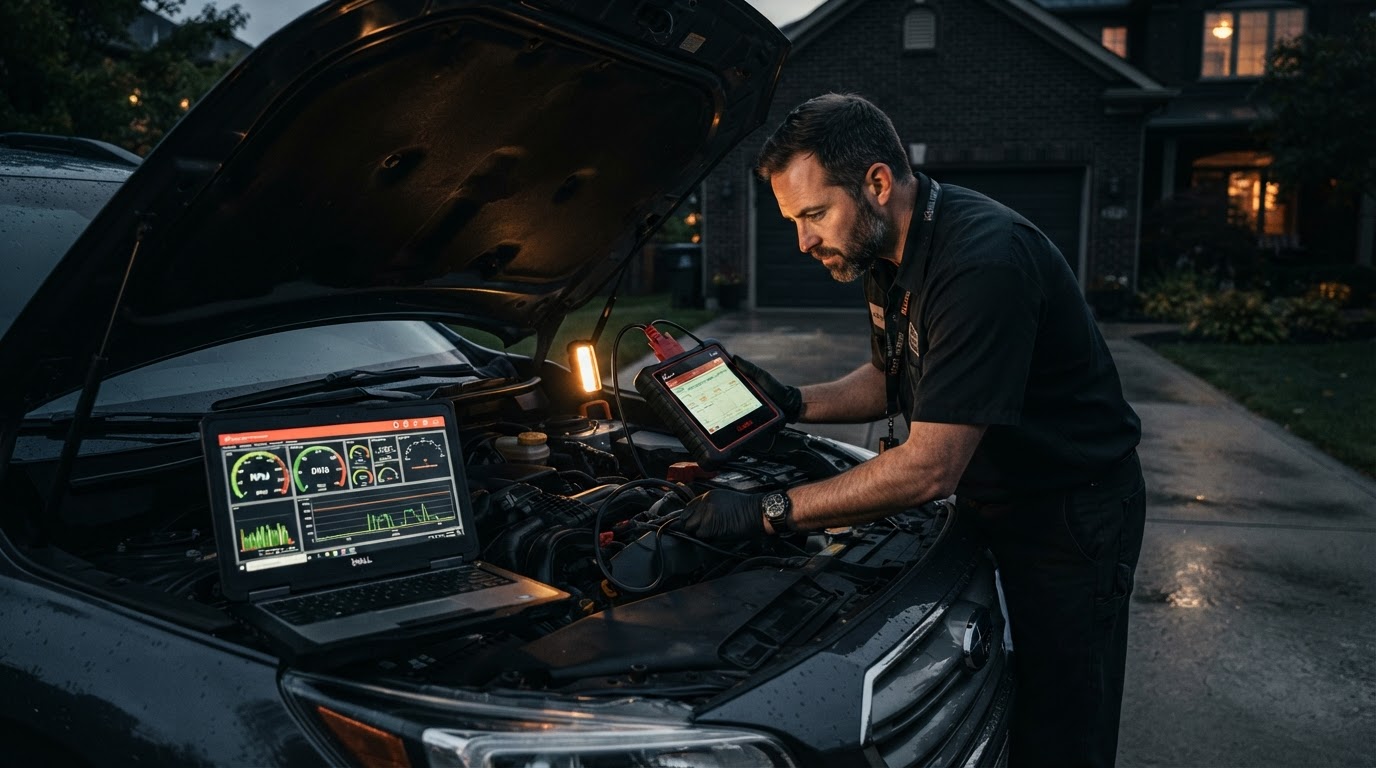
We combine OBD-II scanning with real-world testing to find the actual cause — not just a code.
Diagnostic Scanning & Warning Lights
Modern vehicles store diagnostic trouble codes (DTCs) when a system falls out of spec. We connect a professional OBD-II scanner and read both stored and pending codes, then review live data — sensor voltages, fuel trims, misfire counts — to understand what the engine is actually doing, not just what code it set. A steady check engine light usually points to a non-emergency fault; a flashing light signals an active misfire that can damage the catalytic converter and should be addressed immediately.
Rough Running, Misfires & Performance Symptoms
Rough idle, hesitation, stumbling under load, and loss of power often trace to ignition, fuel, or air delivery problems. We test spark and coil output, fuel pressure and injector operation, and check for vacuum leaks and mass airflow sensor issues. Rather than swapping parts on a guess, we isolate the cylinder or system at fault so you only pay for the repair you actually need.
Starting Problems & No-Start Diagnosis
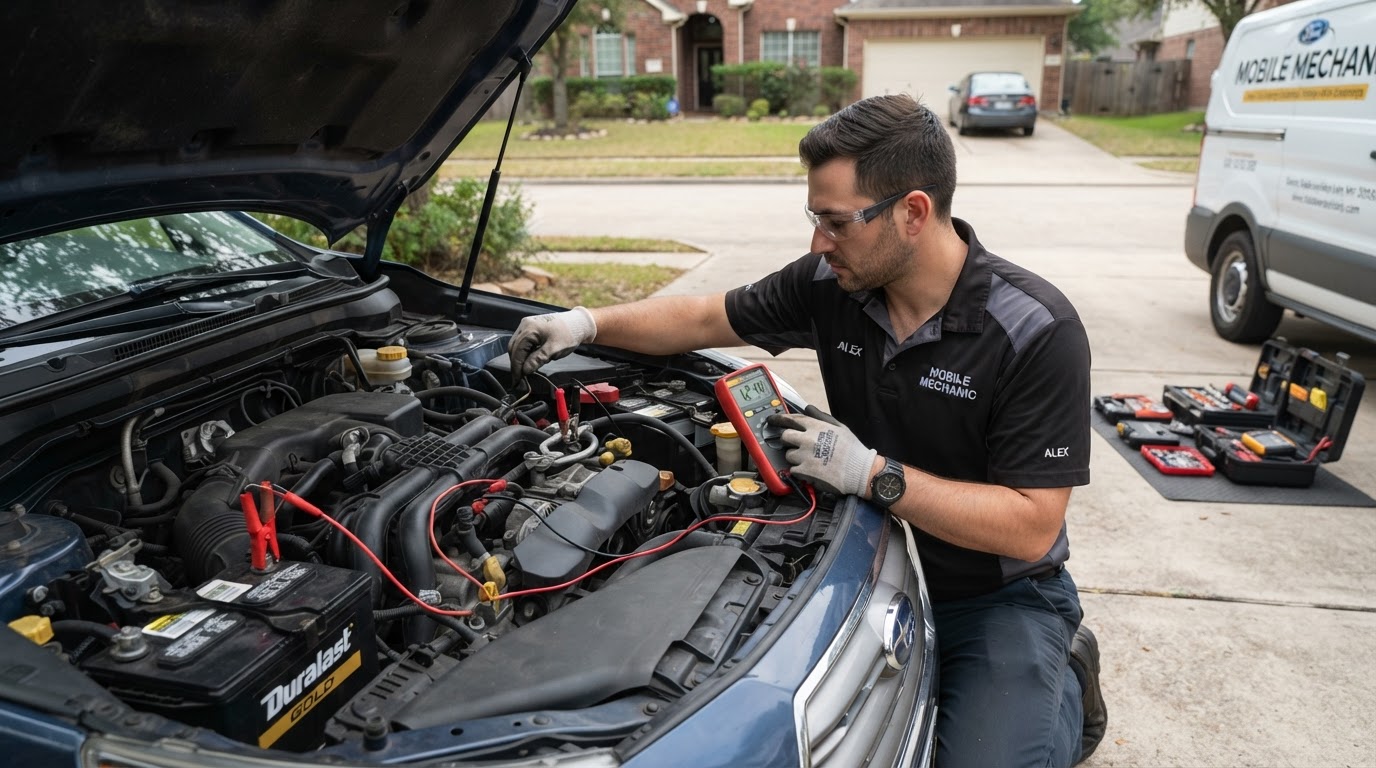
A car that cranks but won't fire, clicks once, or is completely dead each have different root causes. We load-test the battery, check voltage at the starter, verify fuel pressure and injector pulse, and confirm ignition spark — building a clear picture of what's present and what's missing in the start sequence.
Diagnosing Before Replacing Parts
The most expensive repair is the one that didn't fix the problem. Our approach is to diagnose first and quote second: we confirm the failing component through testing before recommending any replacement. That protects you from paying for a sensor, coil, or pump that wasn't the issue.
Understanding Code Limitations
A diagnostic code points to a system or circuit, not always the exact part. A P0301 misfire code tells you cylinder one is misfiring, but the cause could be a spark plug, coil, injector, or vacuum leak. We interpret codes in context with hands-on testing so the code leads to the right repair instead of a parts-swap chain.
What Happens During a Mobile Diagnosis
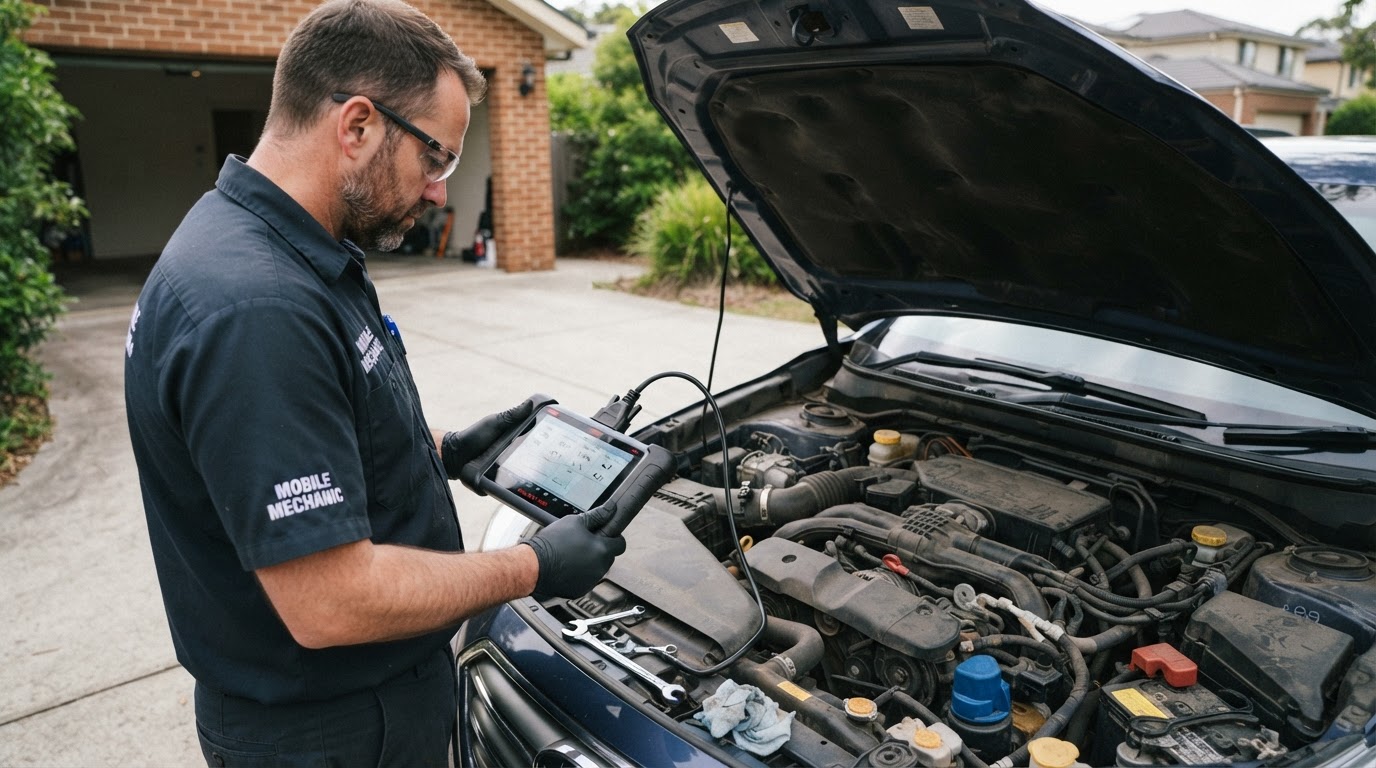
We arrive at your vehicle, connect the scanner, and review codes and live data. Then we perform targeted hands-on checks — visual inspection of wiring and hoses, spark and fuel tests, pressure tests where needed — and walk you through what we found and what it means. You get a clear explanation and a written estimate before any repair begins.
Price Factors
Diagnostic pricing varies with the vehicle, the complexity of the symptom, the testing required, and the time involved. Some faults are found quickly in a scan; intermittent or multi-system problems take longer. We give you an upfront estimate for the diagnostic visit before we begin.
When Shop-Level Testing May Be Necessary
Some diagnoses require equipment that can't travel — such as smoke machines for deep evaporative leak detection, oscilloscope waveform analysis on certain sensors, or in-chassis pressure transducer testing. When that's the case, we tell you honestly and can help coordinate a shop referral rather than guessing on-site.
Diagnostic Tools and Equipment We Bring
Our mobile diagnostic kit includes a professional OBD-II scanner capable of reading manufacturer-specific codes and live data streams, a digital multimeter for voltage and resistance testing, a fuel pressure gauge, a vacuum gauge, and a compression tester for mechanical health checks. We also carry common hand tools, a test light, and a battery load tester so we can evaluate the starting and charging system during the same visit. Having the right equipment on-site means most diagnoses are completed in a single trip — you get an answer the same day instead of waiting for a shop appointment and a second visit to pick up the vehicle.
Common Diagnostic Codes We Investigate in Bloomington
Bloomington's mix of commuter traffic, rural highway miles, and student vehicles that sit through long breaks produces predictable diagnostic patterns. Misfire codes (P0300 series) are common and often trace to worn spark plugs, failing ignition coils, or vacuum leaks — especially on higher-mileage vehicles. Lean codes (P0171, P0174) frequently point to dirty mass airflow sensors or intake leaks. Evaporative emissions codes (P0440 series) appear more in seasonal temperature swings. Charging-system codes and battery warnings spike during winter cold snaps and humid summer heat. Whatever the code, we interpret it in context with hands-on testing rather than treating it as a parts order.
Repair vs. Diagnosis: Understanding the Difference
Diagnosis and repair are separate steps, and understanding that distinction saves you money. A diagnostic visit identifies the actual cause of the symptom — it does not fix it. Once we know what's wrong, we give you a written estimate for the repair and you decide whether to proceed. In many cases we can perform the repair on the same visit if parts are available, but we never start work without your approval. This approach protects you from paying for a repair that doesn't address the real problem, and it gives you the option to comparison-shop or defer non-urgent work.
What Information Helps Us Diagnose Faster
When you call, the more context you can share, the faster and more accurate the diagnosis. Useful details include the year, make, model, and engine size of your vehicle; whether the check engine light is steady or flashing; when the symptom started and whether it's constant or intermittent; any recent repairs, parts replacements, or fuel fill-ups; and whether the problem happens cold, warm, under load, or at idle. Even small details — a smell, a sound, a specific rpm range — can point us toward the right system and shorten the diagnostic time.
Who Needs Diagnostics?
Bloomington drivers with a check engine light on (steady or flashing), a car that cranks but won't fire, rough idle or hesitation, a temperature gauge climbing into the red, a misfire code, or a vehicle that runs differently after a recent repair. If you're about to buy a used car and want hidden codes checked, our pre-purchase inspection covers that too.
Benefits of Mobile Diagnostics
- A real answer instead of a parts-swap chain — we confirm the failing component through testing.
- No tow for most diagnostic visits, since we bring the scanner and tools to your vehicle.
- A clear, written estimate before any repair begins, so you decide what gets fixed.
- An honest recommendation when a problem needs shop-level equipment, including help coordinating a referral.
- Direct explanation from the mechanic doing the testing, in plain language.
Mobile Diagnostics — On-Site in Bloomington
See how we bring this service to your vehicle.
What to Expect
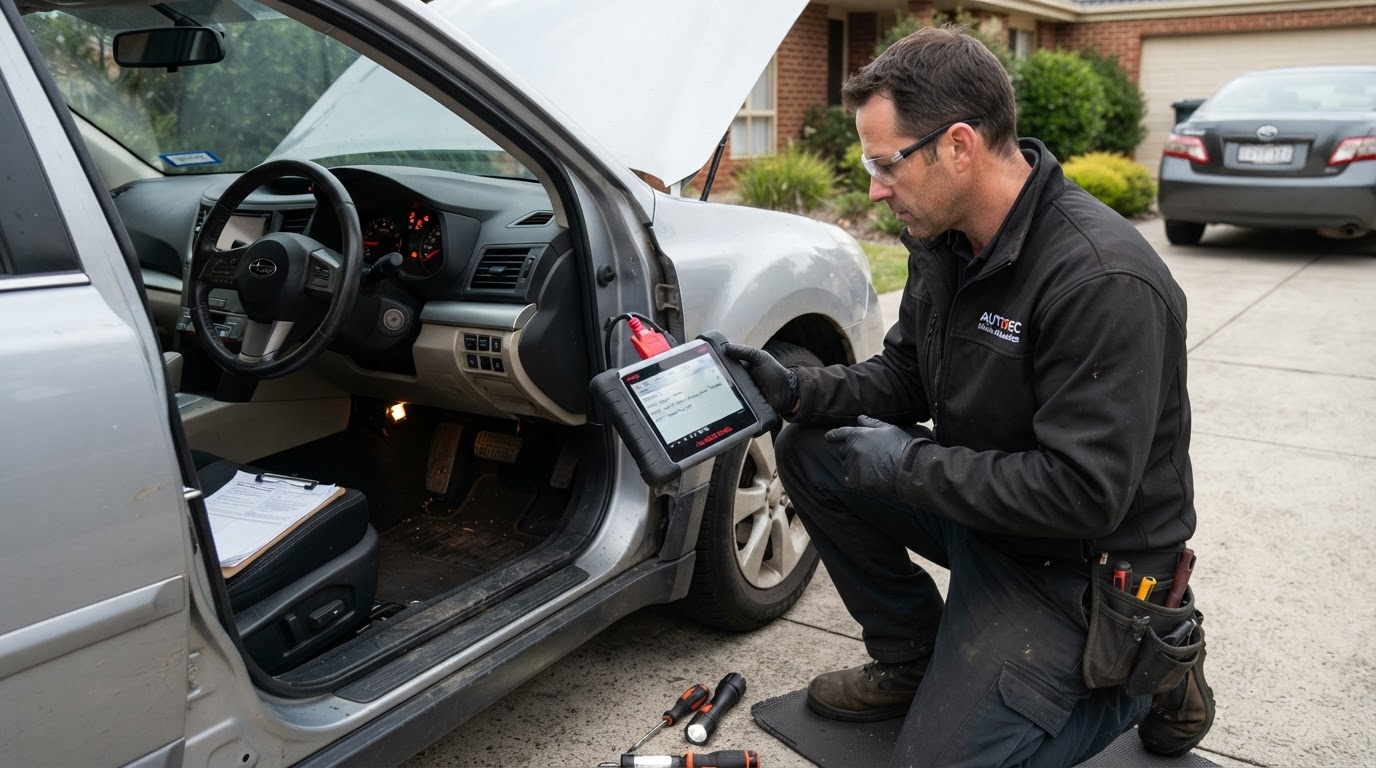
- We arrive at your vehicle and connect a professional OBD-II scanner to read stored and pending codes.
- We review live sensor data — fuel trims, sensor voltages, misfire counts — to understand what the engine is actually doing.
- We perform targeted hands-on checks: visual inspection of wiring and hoses, spark and fuel tests, pressure tests where needed.
- We walk you through what we found, what it means, and what it takes to fix it.
- You receive a written estimate before any repair begins — no work starts without your approval.
Choosing a Diagnostics Provider
- Choose a mechanic who interprets codes in context with hands-on testing, not one who replaces whatever part the code suggests.
- Look for someone who gives a written estimate before any repair and explains the cause in plain language.
- Confirm the diagnostic fee is credited toward the repair if you have them do the work.
- Ask whether the diagnosis can be completed at your location or requires a shop visit.
- Verify 24-hour availability if your symptom — like a flashing check engine light — is urgent.
Questions to Ask Before Scheduling
- Will you test the actual component, or just replace what the code points to?
- Can the diagnosis be done at my home or workplace in Bloomington?
- Is the diagnostic fee credited toward the repair if I have you do the work?
- How long will the diagnostic visit take?
- What happens if the problem needs shop-level equipment you can't bring?
- Are you available after hours if my check engine light is flashing?
Diagnostics — FAQs
Can you diagnose my car at my house in Bloomington?
Yes. We bring professional OBD-II scanning and hands-on testing to your driveway, workplace, or parking spot anywhere in Bloomington, Indiana. Most common diagnostics — check engine lights, no-starts, misfires, and overheating — can be completed on-site.
Will the code tell you exactly which part to replace?
Not always. A code identifies the system or circuit, and the actual failing part is confirmed through testing. We interpret the code in context so you don't pay to replace a part that wasn't the problem.
How long does a mobile diagnostic take?
Most diagnostic visits take 30-60 minutes depending on the symptom and how many systems are involved. Intermittent problems can take longer, and we'll give you a realistic estimate up front.
Do I need to tow my car for diagnostics?
Usually no. If the vehicle is safe to access where it's parked, we can diagnose on-site. If the problem requires shop-level equipment, we'll tell you honestly and help coordinate a referral.
Can you diagnose a flashing check engine light?
Yes, and you should call right away. A flashing check engine light signals an active misfire that can damage the catalytic converter. We test in person at your vehicle — we don't diagnose a flashing light remotely.
What does a diagnostic visit cost?
Diagnostic pricing varies with the vehicle, the complexity of the symptom, the testing required, and the time involved. We give you an upfront estimate for the diagnostic visit before we begin, and that fee is often credited toward the repair if you have us do the work.
Diagnostics Services We Offer
Check Engine Light Diagnostics
Code scanning and root-cause analysis on-site.
Learn moreCar Won't Start Diagnosis
Battery, starter, fuel, and ignition testing.
Learn moreCar Overheating Diagnosis
Cooling system pressure test and inspection.
Learn moreRoadside Assistance
Mobile help when you're stuck on the road.
Learn more